AetherGovern
A Falsification-First Investigation of Governance in the Aether Family
A structured investigation of whether a governance gap genuinely exists in the Aether family, or whether it is already covered by AetherProof (specifications), AetherMesh (Byzantine admission), or a combination of the two. v2.0.0 adds a reference implementation alongside the v0.1.0 hypothesis.
Project
| Field | Value |
|---|---|
| Full title | AetherGovern: A Falsification-First Investigation of Governance in the Aether Family |
| Subtitle | A Falsification-First Investigation of Authority, Policy, and Accountability in Multi-Agent Software Ecosystems |
| Version | 2.0.0 (Reference Implementation) + 0.1.0 (Formal Architecture) |
| Stage | Reference Implementation with Reproducible Experiments |
| License | MIT (code) · CC-BY-4.0 (docs, manuscript) |
| Domain | Distributed Systems / Software Engineering / Institutional Analysis |
| DOI (Zenodo) | 10.5281/zenodo.24054524 |
| Concept DOI | 10.5281/zenodo.24054523 |
| OSF | 10.17605/OSF.IO/TAHC8 |
| PyPI | pypi.org/project/aethergovern (publishing) |
| Record ID | AETHERGOVERN-02 |
Central Question
Is there a body of authorization, policy, accountability, revocation, and dispute-resolution requirements for multi-agent software ecosystems that (i) is not already specified by the four existing dimensions, (ii) is not reducible to verification or to orchestration, (iii) can be specified without reintroducing a central authority, and (iv) yields an observable benefit over existing mechanisms?
The Five Functional Dimensions
| # | Dimension | Focus | Question |
|---|---|---|---|
| 1 | AetherGit | Storage and versioning | How are changes stored and versioned? |
| 2 | AetherFlow | Integration and operational verification | How are changes integrated and verified? |
| 3 | AetherProof | Specification and formal evidence | How is correctness proven? |
| 4 | AetherMesh | Distribution and eventual consistency | How is state synchronized without a central coordinator? |
| 5 | AetherGovern (hypothesis) | Authority and policy | Who is authorized to do what, under which policy? |
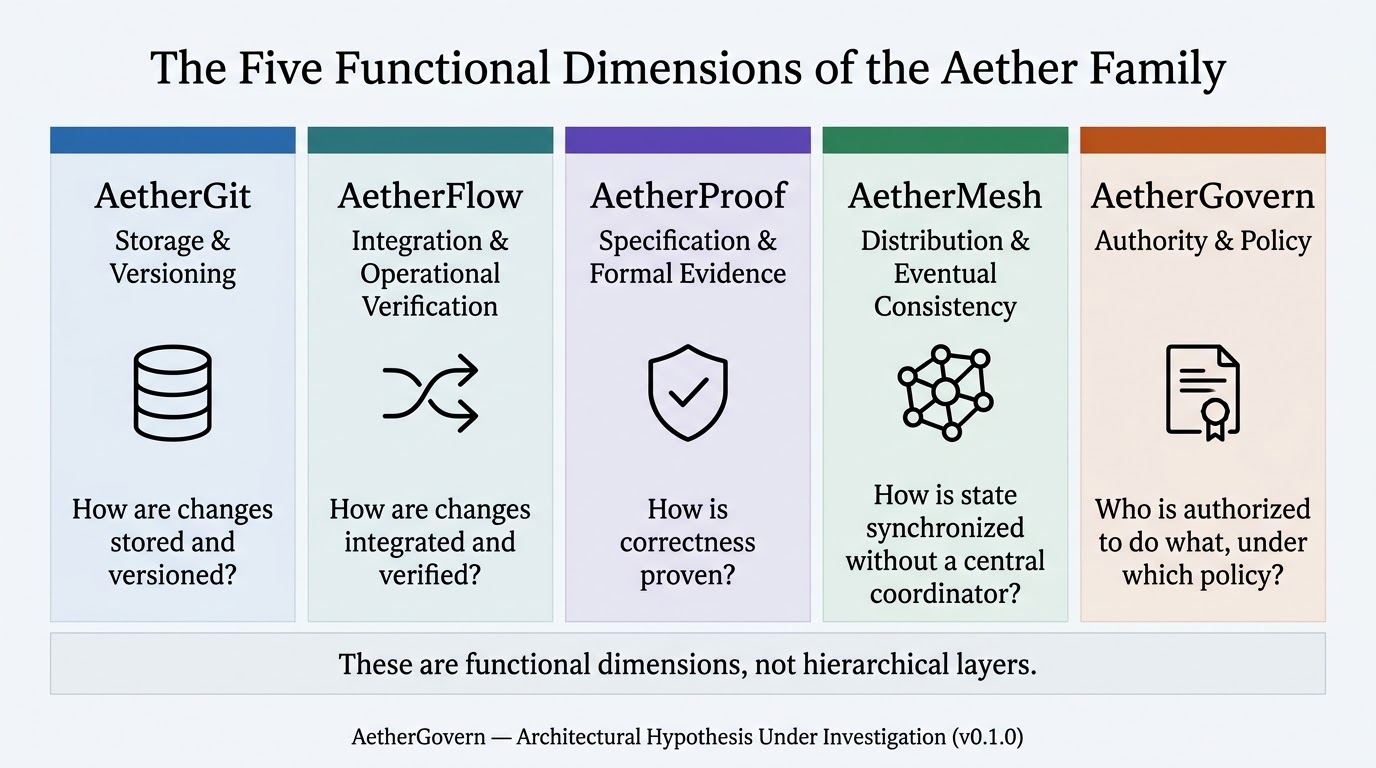
Figure 1 — The Five Functional Dimensions of the Aether Family (AetherGit, AetherFlow, AetherProof, AetherMesh, and the proposed hypothesis AetherGovern). The fifth dimension (AetherGovern) is a hypothesis under investigation, not a confirmed dimension.
Failure Conditions F1–F5
| ID | Claim under test | Status |
|---|---|---|
| F1 | Non-redundancy | Not falsified (R1, R3, R5) |
| F2 | Orthogonality to verification | Not falsified (narrowly) |
| F3 | Boundary with orchestration | Not falsified (decentralized setting) |
| F4 | Decentralizability | Not falsified (with residuals) |
| F5 | Observable benefit | Untested |
Propositions
| # | Proposition | Status |
|---|---|---|
| P1 | Determinism of Causal-Authority Admission | Proof sketch |
| P2 | Monotonicity of Revocation | Proof sketch |
The Five Governance Layers
| Layer | Question | Status |
|---|---|---|
| 1 — Authorization | Who may act? | Hypothesis |
| 2 — Policy | Under which rules? | Hypothesis |
| 3 — Accountability | Who is responsible? | Hypothesis |
| 4 — Revocation | How is authority withdrawn? | Hypothesis |
| 5 — Dispute Resolution | How are conflicts resolved? | Hypothesis |
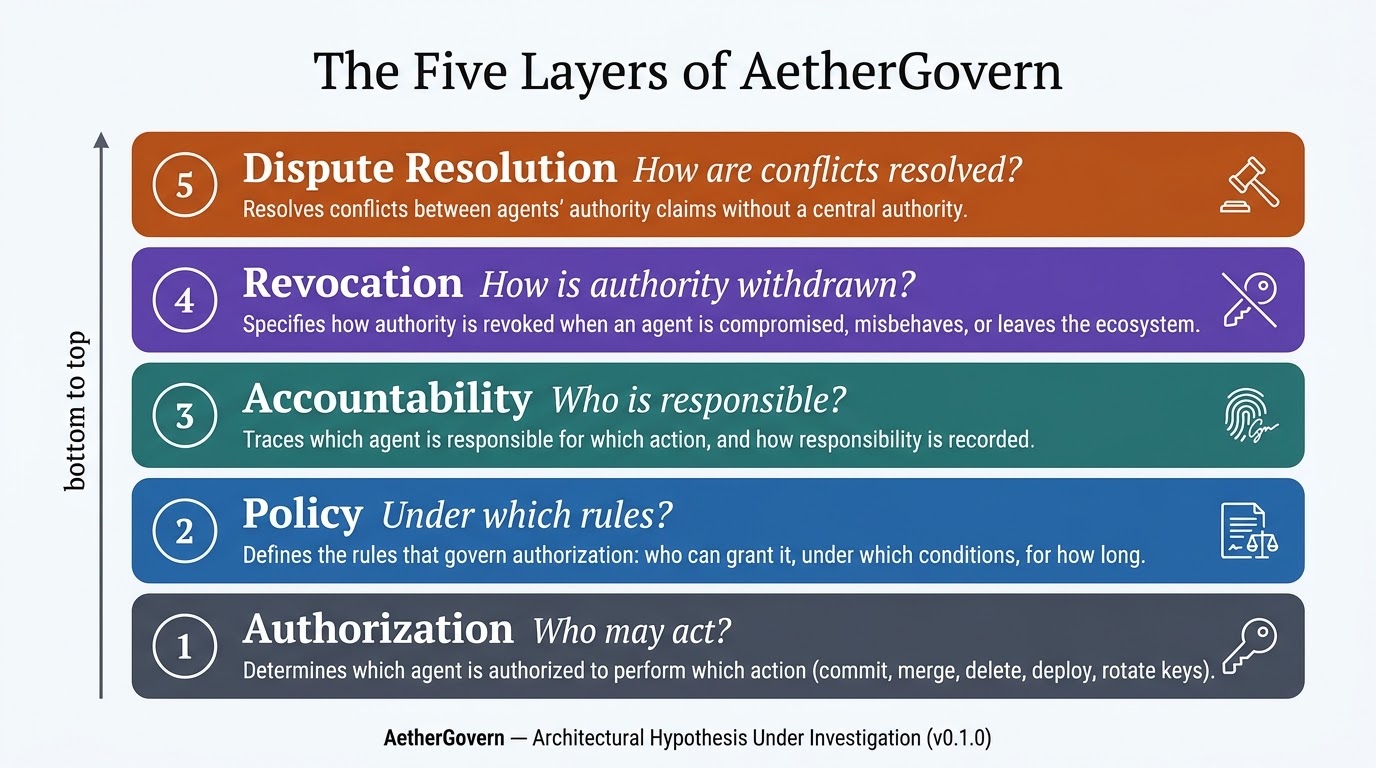
Figure 2 — The five layers of AetherGovern (hypothesis). Ordering reflects conceptual dependency, not an enforcement hierarchy.
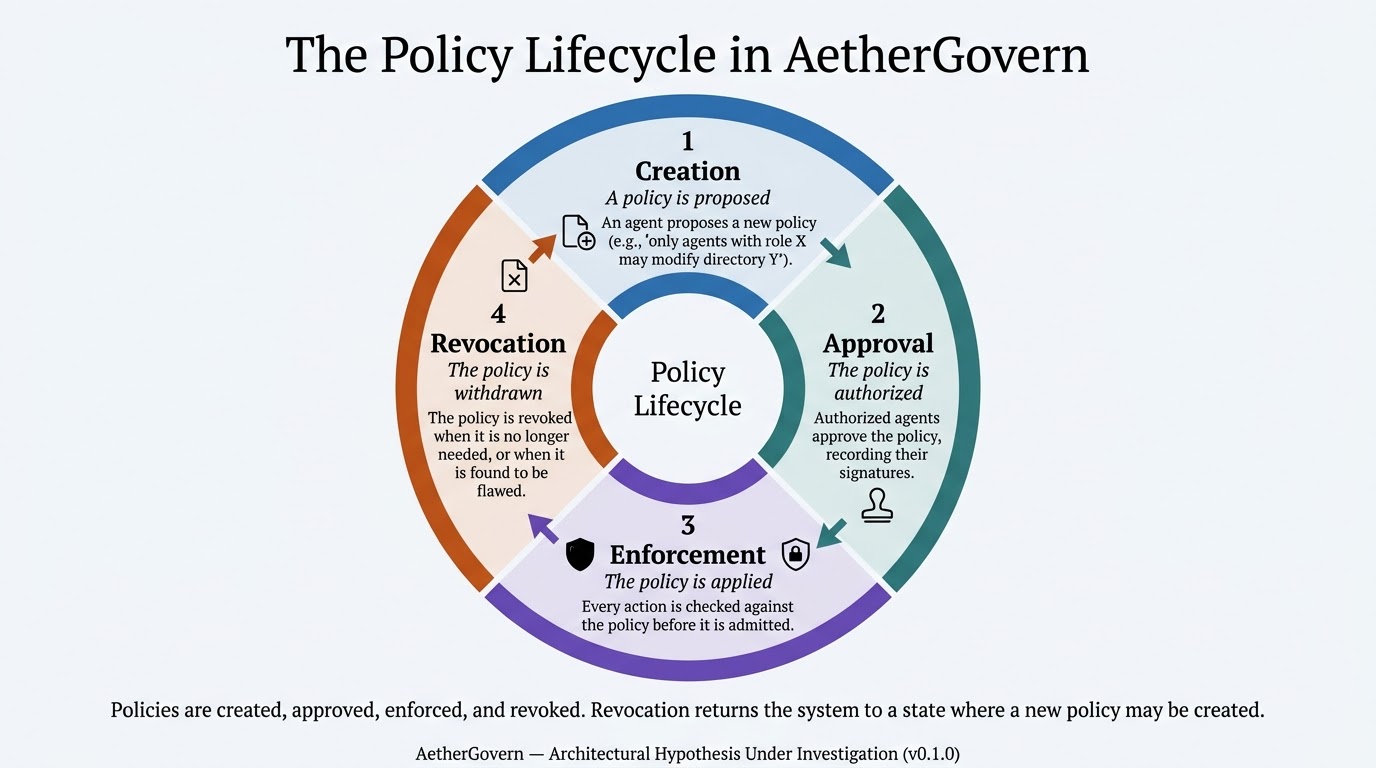
Figure 3 — The policy lifecycle in AetherGovern (hypothesis): creation, approval, enforcement, revocation. Schematic; not a protocol specification.
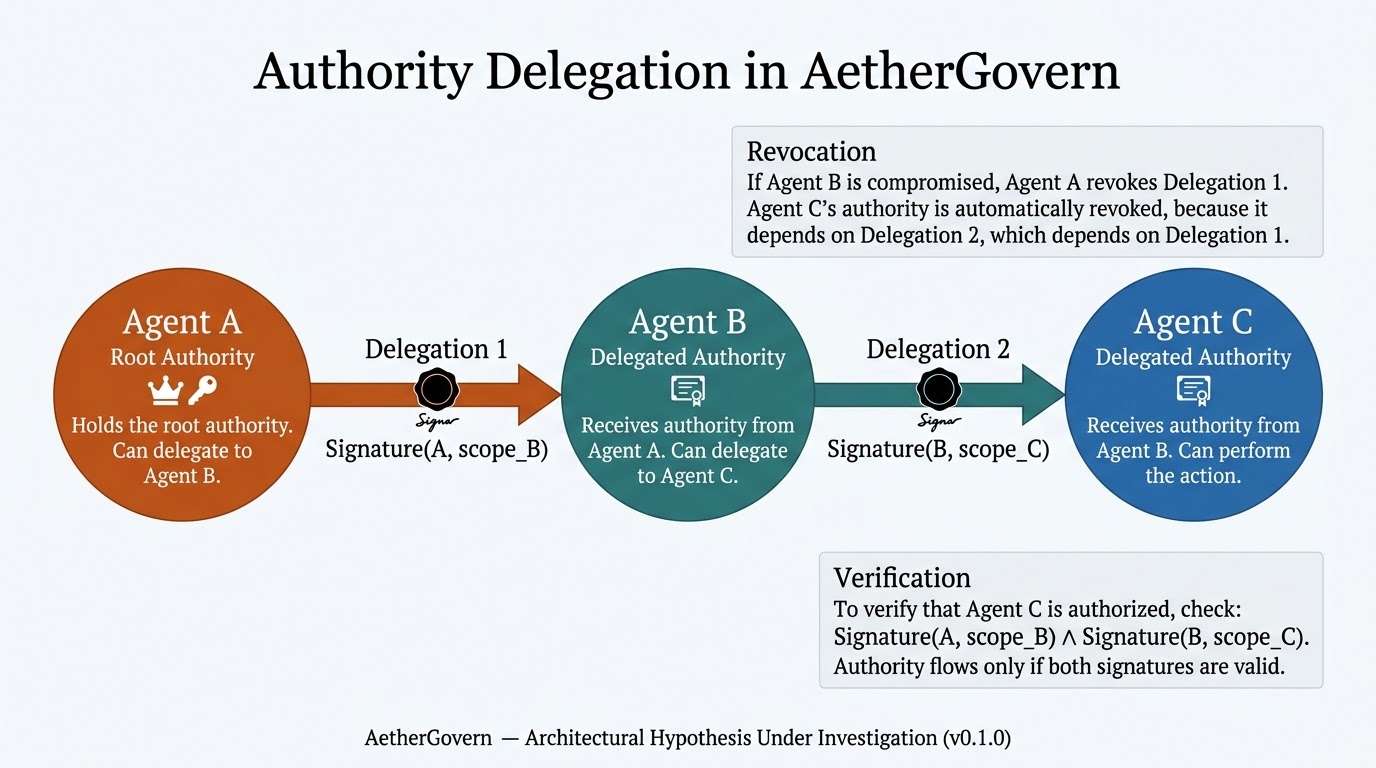
Figure 4 — Authority delegation via cryptographic signature chains in AetherGovern (hypothesis). Verification includes scope attenuation, expiry, and a revocation check.
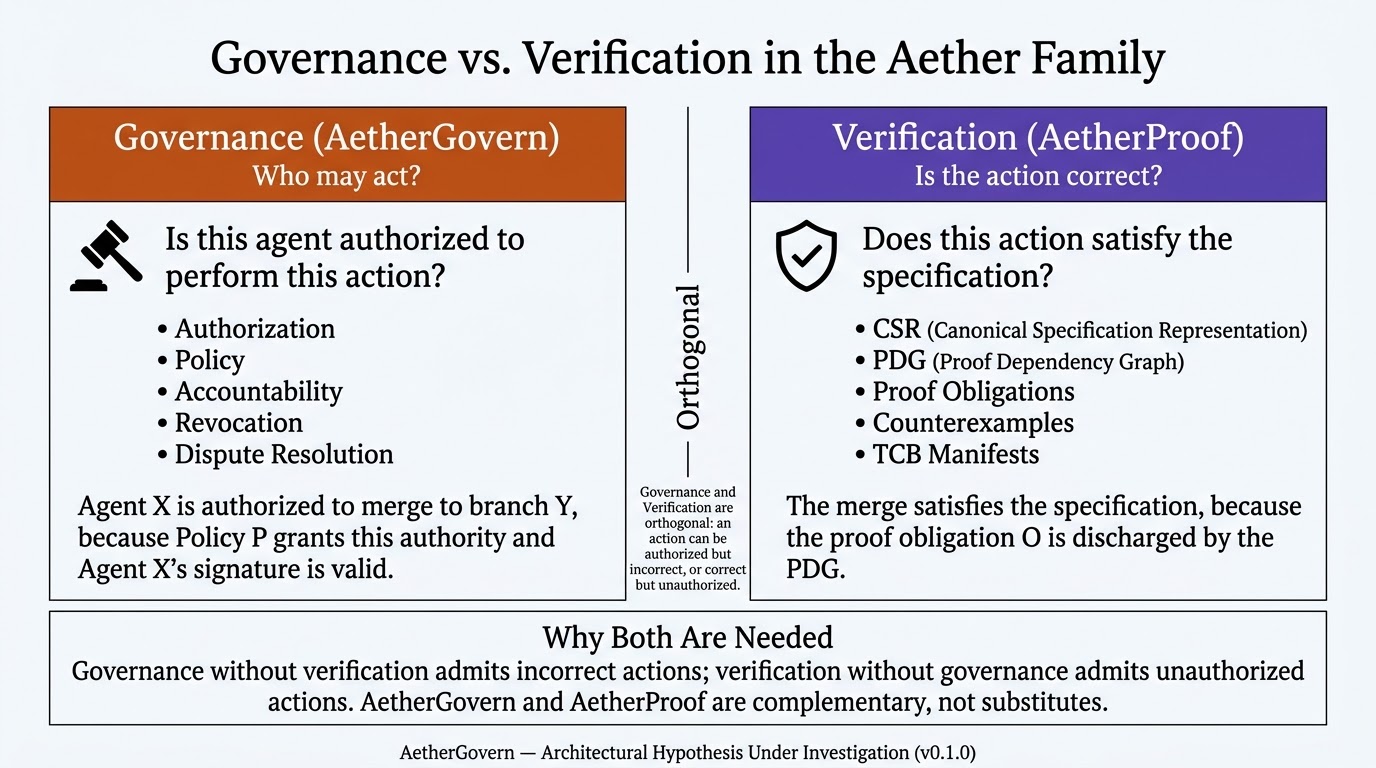
Figure 5 — Governance versus verification in the Aether family. Orthogonality is a hypothesis tested as failure condition F2; the figure was redrawn for this record.
Documents
- AetherGovern Research Paper (PDF) 33 pages · 5 figures · 25 references · 20 open questions. Paper version: v0.1.0. doi.org/10.5281/zenodo.24054524
- OSF Registration Pre-registration and formal record. doi.org/10.17605/OSF.IO/TAHC8
Repositories and Archives
- GitHub Primary. Source code, issues, and pull requests. github.com/gitdeeper15/aethergovern
- GitLab Mirror repository. gitlab.com/gitdeeper15/aethergovern
- Codeberg Mirror repository. codeberg.org/gitdeeper15/aethergovern
- Bitbucket Mirror repository. bitbucket.org/gitdeeper15/aethergovern
-
PyPI Package
aethergovern 2.0.0 — install via
pip install aethergovern(publishing in progress). pypi.org/project/aethergovern - Zenodo (v0.1.0) Citable DOI for the research paper. doi.org/10.5281/zenodo.24054524
- Concept DOI Cite all versions (v0.1.0+). doi.org/10.5281/zenodo.24054523
- ORCID Researcher identity. orcid.org/0009-0003-8903-0029